
Logistics
Moving gold by air: strong room to strong room
Most international bullion travels in the hold of scheduled freighters and passenger aircraft. Here is what happens between our vault door and the destination’s.

Air is the default mode for international bullion movements: fast, frequent and, handled properly, extremely secure. A consignment can leave a London vault in the morning and be in a Dubai or Zurich vault the same night. The aircraft is rarely the risk. The ground handling at each end is where discipline matters.
Before the flight
- Booking as valuable cargo with an airline that offers a strong room at origin and destination, and agreeing the flight in advance.
- Export documentation and customs pre-clearance, including the commercial invoice, packing list and any licences required.
- Sealing and weighing at our vault, with seal numbers and gross weights recorded on the air waybill.
On the day
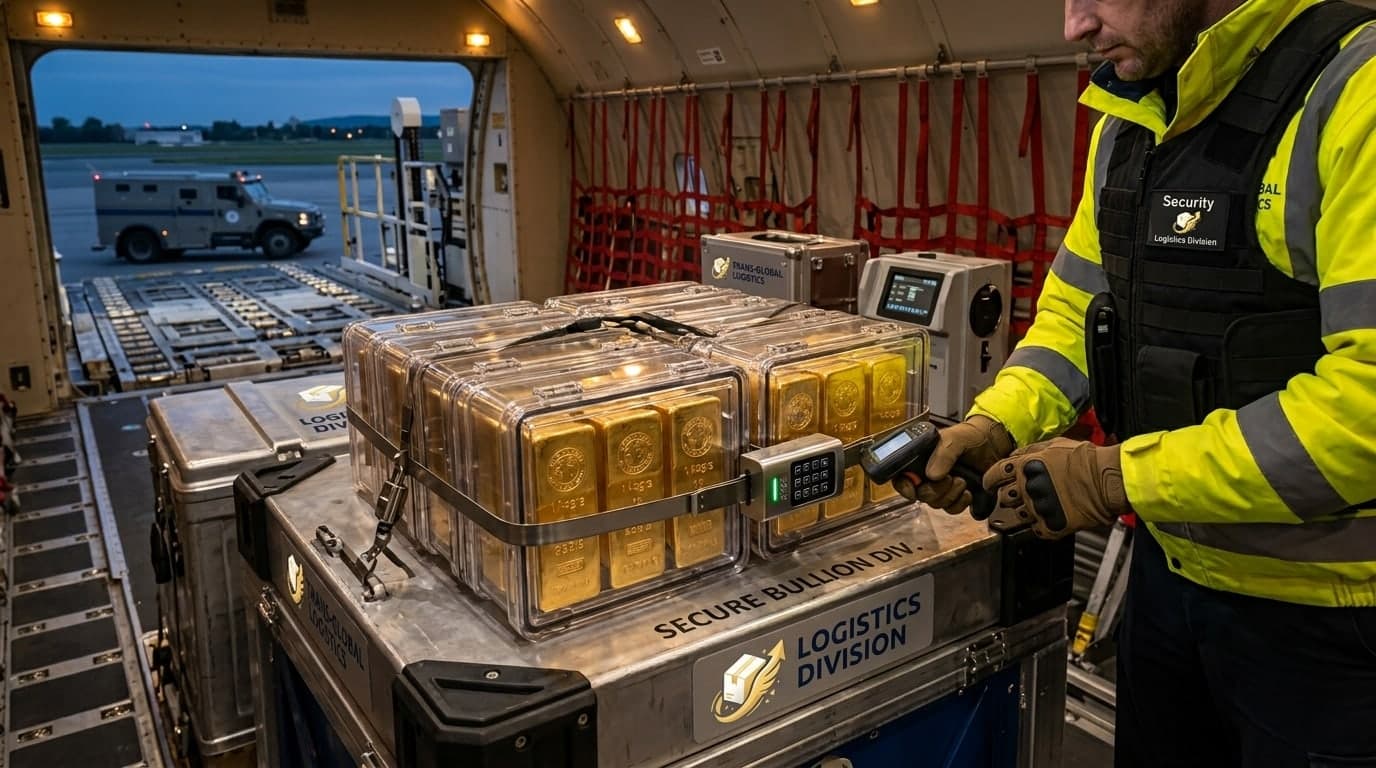
Our armoured vehicle takes the cases airside under escort, directly to the airline’s strong room or to the aircraft. The airline’s valuable-cargo staff check seals and documents against the air waybill before signing. Loading is the last thing to happen before departure, and the cases are among the first things removed on arrival.
At destination
A receiving security company — ours or a vetted partner — meets the aircraft, takes the cases into the destination strong room and handles import clearance. Once released, the consignment travels under escort to the receiving vault, where seals are checked again and the bars are counted and weighed against the manifest.
Every one of those steps generates a signature against a document number you can see in your portal.
The air waybill
The air waybill is the contract of carriage with the airline. Its number — a three-digit airline prefix followed by a serial — is how the consignment is identified throughout the air leg. We record it on your shipment and print it on our own consignment note, alongside the flight and the full bar manifest.
Why liability limits matter here
International carriage by air is governed by the Montreal Convention, which limits the airline’s liability per kilogram unless a higher value is declared and a supplementary charge paid. For gold, declaring full value is usually impractical, which is why specie insurance — not the airline’s liability — is what actually protects the consignment.
Customs and paperwork
Gold crosses borders as goods, so every international movement involves export formalities at origin and import formalities at destination. The details depend on the countries involved, but the documents are broadly the same: a commercial or pro-forma invoice stating value, a packing list matching the bar manifest, the air waybill, and in some cases certificates of origin or permits. Investment gold is often relieved from import VAT or duty, but relief is not automatic and has to be claimed correctly.
Most delays at destination are caused by paperwork that does not match: a value in one currency on the invoice and another on the declaration, a bar count that differs between documents, or a consignee name that is not exactly the one on the permit. We prepare every document from the same shipment record, which removes most of those mismatches before the metal leaves the vault.
Choosing the routing
Direct flights are preferred wherever they exist, because every transfer between aircraft is another hand-over. Where a connection is unavoidable, the transit airport needs a strong room, an airline that will accept valuable cargo on both legs, and a security partner who can supervise the transfer. We also consider timing: an arrival late on a Friday may mean the metal sits in a strong room over a weekend before customs can clear it.
What you will see
Clients can follow each stage in the portal: booking, collection, airside delivery, departure, arrival, customs clearance and delivery to the receiving vault. Each update carries a time and place, and the air waybill number appears alongside the shipment so that you can quote it to the receiving party if needed.
This article is general information, not legal, tax or investment advice. Speak to a qualified adviser about your circumstances.
Keep reading
 Custody4 min read
Allocated or unallocated? What you actually own
Two accounts can show the same number of ounces and mean completely different things. Here is how to tell whether you own bars, or a promise.
Read more Markets3 min read
LBMA Good Delivery, explained for owners
The 400-ounce bar is the currency of the wholesale gold market. Here is what the Good Delivery standard guarantees, what it doesn’t, and why it matters when you sell.
Read more Logistics3 min read
Anatomy of a chain of custody
Every hand-over is a moment where a bar could be swapped, lost or simply undocumented. Here is how a disciplined chain of custody closes each gap.
Read more