
Logistics
Anatomy of a chain of custody
Every hand-over is a moment where a bar could be swapped, lost or simply undocumented. Here is how a disciplined chain of custody closes each gap.

A chain of custody is the unbroken record of who held an object, when, and in what condition. For precious metals it is not paperwork for its own sake: it is the evidence that the bar you sell is the bar you bought, and that it has never been anywhere it shouldn’t have been.
The weak points are the hand-overs
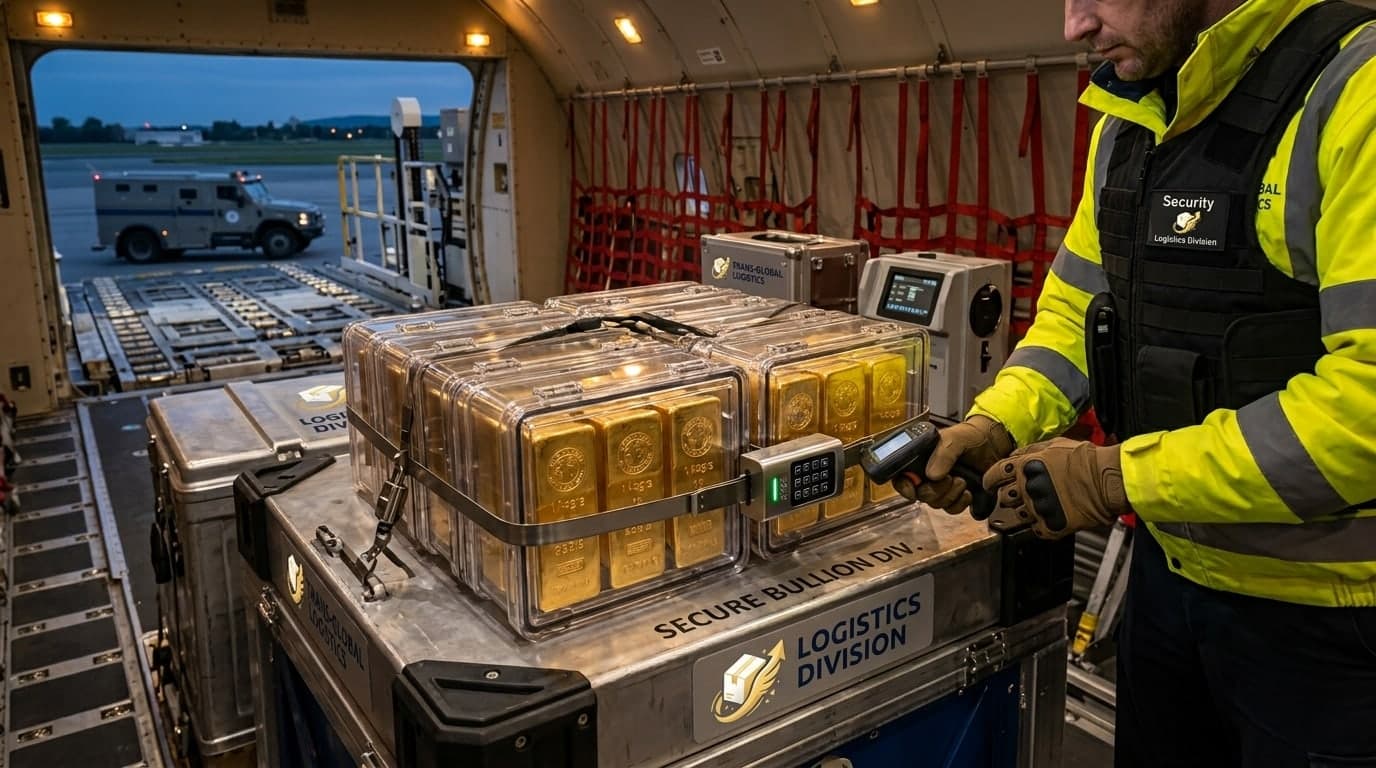
Metal is rarely at risk while it sits in a vault or travels in a sealed vehicle. Risk concentrates at the moments it changes hands: vault to vehicle, vehicle to airside, aircraft hold to strong room, strong room to the receiving vault. Each is a moment where two parties must agree on exactly what is being transferred.
What a disciplined hand-over looks like
- Two people from each side are present. No single person ever handles client metal alone.
- Cases are sealed with numbered, tamper-evident seals before they leave the vault, and the numbers are recorded on the waybill.
- At each hand-over the receiving party checks seal numbers against the document before signing. Any discrepancy is written on the document there and then.
- Hand-overs happen on camera, in controlled areas, at times agreed in advance.
- The signed document travels with the consignment and a copy is filed immediately.
Seals carry the story
A seal does not stop a determined thief. What it does is make interference evident and attributable. If the seal numbers match and the seals are intact at every hand-over, the contents can be presumed unchanged. If they do not match, everyone knows exactly at which hand-over the problem arose — which is precisely the information an insurer, an investigator or a buyer will need.
We design every process around one question: if something went wrong, could we prove exactly where?
Paper and data, together
We generate waybills, manifests, receipts and certificates from a single record. The bar list on a deposit receipt is the same list that later appears on the ownership certificate and on any waybill for a movement. When a tracking update is posted, you see it in your portal straight away, against the same shipment number printed on the documents.
What you should expect to receive
For every movement: a waybill with the full bar manifest and seal numbers, tracking updates at each milestone, and a signed delivery record. For every deposit: a deposit receipt listing every bar and recording the condition on arrival. If a provider cannot give you these, the chain of custody exists only in someone’s memory.
When something does not match
Discrepancies happen, and almost all of them are clerical: a transposed digit in a serial number, a bar weighed on a different scale, a seal number written from memory. What separates a good process from a weak one is not that discrepancies never occur but that they are caught at the hand-over where they arise, before anyone signs.
When our team finds a mismatch, the consignment is not accepted into the vault until it is resolved. The seal and packaging are photographed, the receiving and delivering parties both record what they see, and the sending party is asked to confirm their own records. If the question is about the metal rather than the paperwork, the bar is weighed again and, if necessary, assayed. The outcome — including the original error — stays on the record, because a history that only shows clean hand-overs is less credible than one that shows problems being found and fixed.
Technology helps, but people sign
Scanners, tamper-evident bags, GPS tracking and live camera feeds all make custody stronger, and we use them. But a chain of custody is ultimately a series of statements by named people: I received these items, in this condition, at this time. Every system we run is designed to make those statements easy to give accurately and hard to give carelessly.
- Hand-overs are recorded against the person, not just the company.
- Times are recorded in a single reference time zone, with the local time alongside.
- Corrections are added as new entries; nothing is overwritten.
If you are ever asked to accept a delivery yourself, the same discipline applies: check the seals before signing, write down what you see, and do not sign for more than you have counted.
This article is general information, not legal, tax or investment advice. Speak to a qualified adviser about your circumstances.
Keep reading
 Custody4 min read
Allocated or unallocated? What you actually own
Two accounts can show the same number of ounces and mean completely different things. Here is how to tell whether you own bars, or a promise.
Read more Markets3 min read
LBMA Good Delivery, explained for owners
The 400-ounce bar is the currency of the wholesale gold market. Here is what the Good Delivery standard guarantees, what it doesn’t, and why it matters when you sell.
Read more Insurance3 min read
How specie insurance really works
Carriers’ liability limits are tiny compared with the value of gold. Specie insurance fills the gap — if you understand what it covers and what it asks of you.
Read more